DOWNLOAD our App & Get Amazing Discount
Download Now
Popular Products


Pait Safai Powder (پیٹ صفائی) 200g | Akseer-e-Maida | Price in Pakistan | CHILTAN PURE
60 reviews
Prime Fast Delivery
Made with 100% Organic Herbs
Relieves constipation acidity
Bloating and other gastrointestinal issues
Safe to be used by the whole family
Gross Weight 260Grm
Net Weight 200Grm
- Rs. 999
Rs. 1,110- Rs. 999
- Unit price
- / per


Activated Charcoal Teeth Whitening Powder 50ml | CHILTAN PURE
103 reviews
Prime Fast Delivery
Good For Smokers
Protects Gums
Whitens Teeth Naturally
Prevents from Permanent Staining
Removes Toxins from Mouth
Eliminates Bad Breath
Kills Cavity causing Bacteria
Removes Plaque Build up
50ml
- Rs. 999
Rs. 1,110- Rs. 999
- Unit price
- / per


Red Onion Oil for Hair 200ml | Price in Pakistan | CHILTAN PURE
121 reviews
Prime Fast Delivery
Nourishes Scalp
Prevents Greying
Boosts Hair Growth
Adds Strength & shine
Wards off Dandruff
Rich in Sulphur
Prevents Split-Ends
Used as a Natural Conditioner
200ml
- Rs. 1,099
Rs. 1,220- Rs. 1,099
- Unit price
- / per


Red Onion Shampoo | Sulfate-Free Hair Care | 260ml & 500ml
110 reviews
Prime Fast Delivery
Naturally Low Foaming [SLS FREE]
Boosts Hair Growth
Lessen Dandruff
Reduce Split Ends
Makes Hair Strong
Strengthen Hair Follicles
Calms Itchy & Dry Scalp
Prevent Premature Hair Greying
260ml
500ml
- From Rs. 890
Rs. 1,600- From Rs. 890
- Unit price
- / per


Pinkish Lips & Cheek Tint (گلابی ٹِنٹ) - Organic Liquid stain for lips, Nourish Lips & Hydrate lips all day
112 reviews
Prime Fast Delivery
Rosy-Pink Tint
Long-Lasting
24/7 Stay
Lip Moisturizing
Sheer & Buildablel
Natural-Look
Smudge-Proof
Give Your Face a Fresh Look
Brightens Lips & Cheeks With a Cheery Pop Of Color
30ml
- Rs. 599
Rs. 666- Rs. 599
- Unit price
- / per


Henna Hair & Beard Dye (Chocolate & Coffee) | 200g | CHILTAN PURE
62 reviews
Prime Fast Delivery
Strengthens Hair
Repairs Split Ends
Restricts Hair Fall
Stress Reliever
Improves Scalp Health
Balances pH & Oil Production
Prevents Premature Hair Greying
200gm
- Rs. 799
Rs. 890- Rs. 799
- Unit price
- / per


Vitamin C Serum 30ml | CHILTAN PURE
114 reviews
Helps skin look fresh and radiantSupports a smoother-looking skin textureHelps maintain skin hydrationDesigned for a simple, radiance-focused skincare routine30 ml
- Rs. 750
Rs. 1,220- Rs. 750
- Unit price
- / per


CHILTAN PURE Mix Seeds – Pumpkin, Flax, Sesame & Sunflower Seeds | 200g & 750g
68 reviews
Prime Fast Delivery
Right Fuel for Health
Good Source Of Fiber
Lower Cholesterol
Relieves Diarrhea
Nutritious Source of Plant Protein
Help Lower Blood Pressure
Support Healthy Bones
Reduce Inflammation
Aid Blood Cell Formation
Small200g
Large750g
- From Rs. 699
Rs. 1,350- From Rs. 699
- Unit price
- / per


CHILTAN PURE Glow Facial Kit – 6-Step Professional Facial at Home
294 reviews
Prime Fast Delivery
Step 1,Glow Facial Cleanser
Step 2,Glow Facial Scrub
Step 3,Glow Facial Massaging Cream
Step 4,Glow Skin Polisher
Step 5,Glow Facial Mud Mask
Step 6,Glow Facial Serum
- Rs. 4,599
Rs. 5,090- Rs. 4,599
- Unit price
- / per

-10%
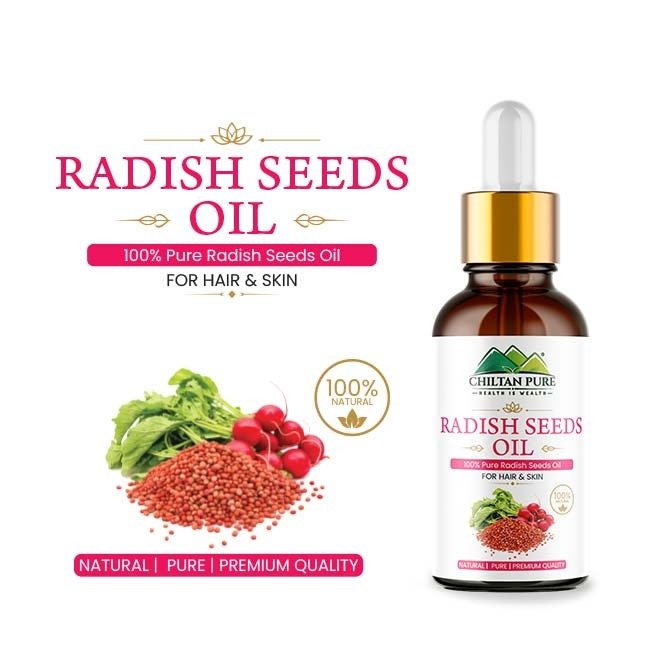

Radish Seeds Oil
2
sold in last
8
hours
Prime Fast Delivery
|
- Rs. 990
Rs. 1,098- Rs. 990
- Unit price
- / per
Pay in 3 Installments of
Rs. 330
Tags:
/
999
/
Carrier Oils
/
Discounted Products
/
Dry Skin
/
NEW ARRIVAL
/
Oils
/
Sensitive Skin
/
Skincare
/
Top Products
/
Top Seller
10 customers are viewing this product


Need More Discount ~ Chat with Sales Person! BARGAIN NOW
Add lightweight botanical nourishment to your routine with CHILTAN PURE Radish Seeds Oil.
Derived from radish seeds, this versatile oil can be used in hair, scalp, skin and massage routines to help support softness, smoothness and a conditioned feel.
Its naturally emollient character makes it useful on dry-looking hair lengths, rough-feeling skin and areas that need extra moisture.
What Is CHILTAN PURE Radish Seeds Oil?
CHILTAN PURE Radish Seeds Oil is a plant-derived oil obtained from radish seeds.
It can be incorporated into cosmetic routines for:
-
Hair conditioning
-
Scalp massage
-
Dry-looking hair ends
-
Skin moisturization
-
Body massage
-
Cuticle care
The exact botanical source, extraction method and grade should always be confirmed from the finished CHILTAN PURE product documentation.
Key Benefits
-
Helps condition dry-looking hair
-
Supports softer, smoother hair
-
Helps improve hair manageability
-
Suitable for scalp massage
-
Supports moisturized-feeling skin
-
Helps soften rough, dry areas
-
Useful for body massage
-
Suitable for hair and skin routines
-
Plant-derived oil
-
Suitable for men and women
What Is Radish Seed Oil?
Radish seed oil is obtained from the seeds of radish plants.
In cosmetic use, it is valued mainly as an emollient oil, meaning it can help soften and condition the surface of hair and skin.
The botanical INCI may be listed as Raphanus Sativus Seed Oil, but this should only be used on the product page if confirmed by the actual CHILTAN PURE documentation.
Radish Seeds Oil for Hair
Radish seed oil can be incorporated into hair-care routines to help dry or rough-looking hair feel:
-
Softer
-
Smoother
-
More manageable
-
Better conditioned
-
Less rough through the lengths
Use a small amount to avoid making fine hair feel heavy.
Radish Seeds Oil for Dry Hair
Dry hair often benefits from additional emollient care.
Apply a small amount to the mid-lengths and ends before shampooing or use sparingly after washing to help support a smoother finish.
Radish Seeds Oil for Frizzy-Looking Hair
A light application over the hair lengths can help smooth the surface and reduce the appearance of roughness.
For best results, apply only a few drops and distribute evenly.
Radish Seeds Oil for Hair Ends
Dry ends can feel rough and look dull.
Rub one or two drops between the palms and lightly apply to the ends of the hair.
Avoid over-application, especially on fine hair.
Radish Seeds Oil for Scalp Massage
The oil may be used as part of a regular scalp massage routine.
Apply a small amount to the scalp and massage gently with fingertips.
Scalp massage can be relaxing, but the oil should not automatically be described as a treatment for hair loss or scalp disease.
Does Radish Seeds Oil Help Hair Growth?
Radish seed oil should not be marketed as a proven hair-growth treatment unless the finished product has appropriate supporting evidence.
Its main cosmetic role is to condition the hair and scalp.
Persistent hair loss should be assessed by an appropriate healthcare professional.
Does Radish Seeds Oil Stop Hair Fall?
It should not be presented as a treatment for hair loss.
Conditioning oils can improve hair feel and reduce roughness, but hair shedding can have many different causes.
Radish Seeds Oil for Skin
As an emollient oil, Radish Seeds Oil may help dry skin feel softer and more conditioned.
It can be used on areas such as:
-
Arms
-
Legs
-
Hands
-
Elbows
-
Knees
-
Cuticles
Apply to clean skin and massage gently.
Radish Seeds Oil for Dry Skin
Dry skin may benefit from using a small amount of oil after moisturizer or over slightly damp skin.
This can help support moisture retention and reduce a rough, dry feel.
Radish Seeds Oil for Body Massage
Radish Seeds Oil may be used alone or blended into a suitable massage-oil formulation.
Apply a comfortable amount to intact skin and massage gently.
Avoid broken or irritated areas.
Radish Seeds Oil for Hands & Cuticles
Massage a small amount into dry hands, nail edges and cuticles to help soften and condition rough-feeling areas.
It can be especially useful as part of an evening hand-care routine.
Radish Seeds Oil for Elbows & Knees
Dry elbows and knees may benefit from additional emollient care.
Apply a small amount after bathing or before bedtime and massage until evenly distributed.
Can You Use Radish Seeds Oil on the Face?
Potentially, depending on individual skin type and the product's cosmetic grade.
If using on the face:
-
Start with a very small amount
-
Patch test first
-
Avoid the eye area
-
Discontinue if congestion or irritation develops
Oily or acne-prone skin may prefer lighter facial products.
Is Radish Seeds Oil Good for Oily Skin?
Oily skin can still use facial oils, but not everyone needs them.
Use a minimal amount and monitor how your skin responds.
Is Radish Seeds Oil Good for Dry Skin?
Yes, an emollient plant oil can help dry skin feel softer and more comfortable.
It works especially well as a finishing layer over moisturizer.
Is Radish Seeds Oil Good for Sensitive Skin?
Sensitive skin should patch test before regular use.
Botanical oils can still cause irritation or allergic reactions in some individuals.
How to Use Radish Seeds Oil for Hair
Step 1 – Dispense a Small Amount
Take a few drops in your palm.
Step 2 – Apply to Hair
Distribute through the mid-lengths and ends.
Step 3 – Leave as Desired
Use as a light leave-in oil or pre-shampoo treatment according to your hair needs.
Step 4 – Shampoo If Required
If used generously as a pre-wash treatment, cleanse the hair thoroughly afterward.
How to Use Radish Seeds Oil for Scalp Massage
-
Apply a small amount to the scalp
-
Massage gently with fingertips
-
Avoid aggressive scratching
-
Leave for the desired period
-
Shampoo thoroughly if needed
How to Use Radish Seeds Oil for Skin
Apply a small amount to clean skin and massage gently.
For dry skin, it can be applied after body lotion to help support a softer, more conditioned feel.
How Often Can You Use Radish Seeds Oil?
Use according to your hair or skin needs.
Some users may apply it several times per week, while others may prefer occasional use.
Start with a small amount and adjust as needed.
Can You Use It Every Day?
Yes, if your skin or hair tolerates it well.
Daily use is usually best with a small quantity to avoid an overly oily feel.
Can You Leave Radish Seeds Oil in Hair Overnight?
It may be used as an overnight hair oil if your scalp and hair tolerate it.
Apply only a moderate amount and protect bedding if necessary.
Wash thoroughly the following day.
Can You Mix Radish Seeds Oil with Other Oils?
Yes.
It may be blended with compatible cosmetic oils such as:
-
Jojoba oil
-
Almond oil
-
Coconut oil
-
Argan oil
-
Castor oil
The final blend should be adjusted according to hair or skin needs.
Can You Mix It with Hair Conditioner?
A small amount may be blended with a suitable conditioner immediately before application.
Do not add oil directly into the full conditioner container unless the formulation has been properly tested.
Can You Use It with Hair Serum?
Yes.
If using both products, apply lightweight products first and use only a small amount of oil as the finishing step.
Can You Use It After Shampooing?
Yes.
Apply a very small amount to damp or dry hair lengths and ends.
Too much oil may make hair appear greasy.
Can Men Use Radish Seeds Oil?
Yes.
It can be incorporated into hair, beard, scalp or body-care routines according to individual needs.
Can Women Use Radish Seeds Oil?
Yes.
It can be used in hair and skin-care routines according to personal preference.
Can You Use It for Beard Care?
A small amount may be used to condition beard hair and the skin underneath.
Apply sparingly to avoid an oily finish.
Does Radish Seeds Oil Make Hair Shiny?
By smoothing and conditioning the hair surface, it may help hair appear softer and more naturally glossy.
It does not permanently change the hair structure.
Does Radish Seeds Oil Repair Damaged Hair?
It can improve the feel and appearance of dry or damaged-looking hair.
However, cosmetic oils cannot permanently reverse structural hair damage.
Does Radish Seeds Oil Help Split Ends?
It may temporarily improve the appearance and feel of dry split ends.
Only trimming can physically remove split ends.
Does Radish Seeds Oil Brighten Skin?
Its main role is moisturization and conditioning.
It should not automatically be marketed as a skin-brightening or pigmentation treatment.
Does Radish Seeds Oil Remove Dark Spots?
No specific dark-spot claim should be made unless supported by the finished formulation and appropriate evidence.
Ingredients Explained
The complete INCI ingredient list printed on CHILTAN PURE Radish Seeds Oil packaging should always be considered the authoritative formulation reference.
Radish Seed Oil
Radish seed oil is a plant-derived emollient used in cosmetic formulations to help condition hair and skin.
Important Ingredient Note
Do not automatically claim that the product is:
-
Cold pressed
-
Organic
-
Unrefined
-
Extra virgin
-
Food grade
-
100% pure
unless these claims are confirmed by the actual CHILTAN PURE product specifications.
Is Radish Seeds Oil Edible?
Do not ingest the product unless the specific CHILTAN PURE grade is clearly certified and labeled for food use.
Cosmetic-grade oils should be used externally.
Tips for Best Results
-
Start with a small amount
-
Apply mainly to dry hair lengths
-
Massage gently into the scalp
-
Use on clean skin
-
Follow moisturizer with oil for dry skin
-
Patch test before facial use
-
Avoid over-application
-
Store away from excessive heat and light
Common Mistakes
Applying Too Much
Excess oil can make hair and skin feel greasy.
Applying Heavily to Fine Hair
Fine hair may become weighed down easily.
Using on Irritated Skin
Avoid applying botanical oils to broken or severely irritated areas.
Expecting Medical Hair-Growth Results
Cosmetic oils primarily condition hair and skin rather than treating medical hair-loss conditions.
Important Precautions
For external cosmetic use only unless specifically certified otherwise.
-
Avoid direct eye contact
-
Do not apply to open wounds
-
Patch test before regular use
-
Discontinue if irritation develops
-
Do not ingest unless labeled food grade
-
Keep out of reach of children
Storage Instructions
Store in a cool, dry place away from direct sunlight and excessive heat.
Keep the bottle properly closed after use to help maintain product quality.
Frequently Asked Questions
What is CHILTAN PURE Radish Seeds Oil?
It is a plant-derived oil designed for cosmetic hair, scalp and skin-care routines.
What is Radish Seeds Oil used for?
It can be used for hair conditioning, scalp massage, body moisturization and general beauty care.
Is it good for dry hair?
Yes. It can help dry hair feel softer and smoother.
Can I apply it to my scalp?
Yes, as part of a gentle scalp massage routine.
Does it grow hair?
It should not be considered a proven hair-growth treatment.
Does it stop hair fall?
No medical hair-loss claim should be made without appropriate evidence.
Can I use it on my skin?
Yes, on intact skin according to individual tolerance.
Is it good for dry skin?
Yes. Its emollient properties can help support softer-feeling skin.
Can I use it on my face?
Potentially, but patch test first and use only a small amount.
Can oily skin use it?
Yes, but oily or acne-prone skin may prefer minimal use.
Can I use it every day?
Yes, if your hair or skin tolerates it well.
Can I leave it in my hair overnight?
Yes, if comfortable for your scalp and hair.
Can I mix it with coconut oil?
Yes.
Can I mix it with castor oil?
Yes, if the blend suits your hair and scalp.
Related Products
Example product title
- Rs. 990
Rs. 1,098- Rs. 990
- Unit price
- / per
Example product title
- Rs. 990
Rs. 1,098- Rs. 990
- Unit price
- / per
Example product title
- Rs. 990
Rs. 1,098- Rs. 990
- Unit price
- / per
Example product title
- Rs. 990
Rs. 1,098- Rs. 990
- Unit price
- / per
Example product title
- Rs. 990
Rs. 1,098- Rs. 990
- Unit price
- / per
Example product title
- Rs. 990
Rs. 1,098- Rs. 990
- Unit price
- / per
Example product title
- Rs. 990
Rs. 1,098- Rs. 990
- Unit price
- / per
Example product title
- Rs. 990
Rs. 1,098- Rs. 990
- Unit price
- / per
Example product title
- Rs. 990
Rs. 1,098- Rs. 990
- Unit price
- / per
Example product title
- Rs. 990
Rs. 1,098- Rs. 990
- Unit price
- / per
Recently Viewed Products
Example product title
- Rs. 990
Rs. 1,098- Rs. 990
- Unit price
- / per
Example product title
- Rs. 990
Rs. 1,098- Rs. 990
- Unit price
- / per
Example product title
- Rs. 990
Rs. 1,098- Rs. 990
- Unit price
- / per
Example product title
- Rs. 990
Rs. 1,098- Rs. 990
- Unit price
- / per
Example product title
- Rs. 990
Rs. 1,098- Rs. 990
- Unit price
- / per
Example product title
- Rs. 990
Rs. 1,098- Rs. 990
- Unit price
- / per
Example product title
- Rs. 990
Rs. 1,098- Rs. 990
- Unit price
- / per
Example product title
- Rs. 990
Rs. 1,098- Rs. 990
- Unit price
- / per
Example product title
- Rs. 990
Rs. 1,098- Rs. 990
- Unit price
- / per
Example product title
- Rs. 990
Rs. 1,098- Rs. 990
- Unit price
- / per
- Choosing a selection results in a full page refresh.